Showing posts with label social networking sites. Show all posts

Monday, November 26, 2007

Link bait in search engine optimization

The quantity and quality of inbound links are two of the many metrics used by a search engine ranking algorithm to rank a website. Link bait creation falls under the task of link building, and aims to increase the quantity of high-quality, relevant links to a website. Part of successful linkbaiting is devising a mini-PR campaign around the release of a link bait article so that bloggers and social media users are made aware and can help promote the piece in tandem. Social media traffic can generate a substantial amount of links to a single web page. Sustainable link bait is rooted in quality content.

Types of link bait

Although there are no clear-cut subdivisions within link bait, many attempt to divide them into types of hooks. This is a short list of some of the most common approaches with brief descriptions:

  • Informational Hooks - Provide information that a reader may find very useful. Some rare tips and tricks or any personal experience through which readers can benefit.
  • News Hooks - Provide fresh information and garner citations and links as the news spreads.
  • Humor Hooks - Tell a funny story or a joke. A bizarre picture of your subject or mocking cartoons can also prove to be a link bait.
  • Evil Hooks - Saying something unpopular or mean may also yield a lot of attention. Writing about something that is not appealing about a product or a popular blogger. Provide strong reasons for it.
  • Tool Hooks - Create some sort of tool that is useful enough that people link to it.
Examples of linkbait

For example, Fetch Softworks has just announced their Take Fetch Back to School, Win a MacBook Contest (4 runners-up win new iPod Nanos). This contest should be great linkbait because it is geared to students, staff and faculty just beginning the academic year; offers great prizes; and is happening at a time when some of those prizes, the new iPods, are making a lot of news. As a user of their product I've already started pondering what to write, and as a blogger I've already linked to them. So I think it's working!

When to use linkbait?

Like your birthday present, linkbait is for special occasions, meant to add to your content rather than replace it. The bait is only part of the overall mix. If you tried to use linkbait in every blog post you would soon end up with a site lacking in continuity. That wouldn't really serve your goals. But on occasion, if you come up with a clever idea that is related to your goals, adds value to your regular content, and attracts attention, then go for it. Strategic bits of linkbait can help you expand your readership, acquire more incoming links and raise your rankings while adding a bit of excitement for your regular readers.

I could proceed to bore you with more details, caveats, pros and cons, but plenty of others have already written on the topic. If you are considering adding linkbait to your marketing toolkit, the following resources should give you much of what you need to know.

Linkbait Resources

Source: http://www.cornwallseo.com

Thursday, October 11, 2007

SEO : Google,Yahoo,MSN

Google (SEO) Search Engine Optimization

A well built site is useless unless people know where to find you. This is where need of search engine optimization arises. The methodology of Search Engine Optimization depends on your knowledge as to how Google ranks it index. Since only the engineers employed by Google know the answer, it is up to the rest of us to speculate on what may work, and what we know doesn't work. The easier your make your site to be understood by Google, the better chances you'll have of getting top spots in Google's index.

There are some guidelines or techniques which are helpful to get higher ranking in google as follows:

  • On page optimization
    • Keyword analyzing
    • Meta tags analyzing
    • Checking Page Rank Leak
    • HTML Validation
    • Broken link checking
    • Assurance of unique content
  • Off page optimization
    • Link building
      • Reciprocal link building
      • One way link building
      • Three way link building
    • Site submission
    • Directory Submission
    • Article writing
    • Article Submission
    • Press Release submission
    • Software submission (If any)

SEO for Yahoo

Yahoo! is the second most popular from the three major search engines and includes an enormous network of websites. The algorithm of Yahoo itself can pose a problem for some SEO's as we optimize client websites to rank highly on multiple search engines due to the way that it differs from Google and MSN. That said, any issue can be addressed provided that the right attention is given to the right details.

There are some guidelines or techniques which are helpful to get higher ranking in Yahoo. On Yahoo! the major areas are as follows:

  • Keyword density
  • Site structure
  • Backlinks

Keyword Density

Keyword Density is the most important factor that yahoo cosider while ranking websites. Generally you will see a range that appears much higher is 5.0 to 8.0%. Beyond this range or crossing this range your ranking in yahoo will go down on regular basis and after certain time your website will be removed from Yahoo's index.

Site structure

Site Structure is more important factor on Yahoo! for two key reasons. First, the site structure determines the order in which your page content gets seen by the search engines and thus, which content will be given the highest priority. Content that occurs higher up in the code of your page is given a higher weight than content lower down in the code. Second, a properly structured site will be lower in code through the use of CSS, reduced or eliminated table use, etc. The reduction in code will push the content higher up the page as far as a search engine is concerned and thus, it will be given more weight.

Backlinks

Like in the other major search engines, having a solid backlink count from relevant sites using good anchor text practices is a major factor on Yahoo! for any reasonably competitive phrase. When it comes to calculating backlinks Yahoo! is far more similar to Google than MSN.

SEO for MSN

Like all of the major search engines, MSN also builds their index of sites using spiders to crawl the web finding new and changed information. This information is then processed by the MSN servers using complex algorithms to determine which sites are most relevant to the search query entered. All search engine algorithms are mathematical and thus, there is a fixed set of rules and factors which, if addressed correctly, will result in a high ranking.

Factors to be considered while optimizing for MSN:

  • Page Content
  • Linking Structure
  • Number of pages
  • Title, Meta & head Tags

The above factors if addressed correctly, will have very significant results on your rankings.

Page Content:

The content of your page must be perfect. What I mean by this is that the content must appeal to both the search engines and the algorithms. In order to write properly for the visitors you must be able to write clearly and in language that is both appealing and understandable to your target market.

Internal Linking Structure:

The way your pages link together tells the search engines what the page is about and also allows them to easily (or not-so-easily) work their way to your internal pages. If your site has an image or script-based navigation it is important to also use text links either in your content, in a footer, or both. The text links are easy to follow for a spider and perhaps more importantly, the text links allow you the opportunity to tell the spiders what a specific page is about though the anchor text and, in the case of footers, allows you to add in more instances of the targeted phrases outside of your general content area.

The Number Of Pages & Their Relevancy:

MSN wants to please their visitors. For this reason they want to insure that highest likelihood that a searcher will find what they need once they get to your site. For this reason a larger site with unified content will rank higher that a smaller site or a site with varying content topics. (note: this assumes that all else is equal in regards to the other ranking factors)

When you are optimizing your site for MSN be sure to take some time to built quality content. Do a search on your major competitors to see how large their sites are, over time you will want to build yours to the same range through general content creation or the addition of a blog or forum to your site.

Titles, Heading Tags & Special Formats:

Titles are the single most important piece of code our your entire web page for two reasons. The first is that it holds a very high level of weight in the algorithm. the second reason is that it is your window to the world. When someone runs a search the results will generally show your page title in the search results. This means that a human visitor has to be drawn to click on your title or rankings your site is a futile effort (this isn't about bragging rights, it's about return on investment).

Heading tags are used to specify significant portions of content. The most commonly used is the H1 tag though there are obviously others (or they wouldn't bother numbering them would they). The H1 tag is given a significant amount of weight in the algorithm provided that it is not abused though overuse (it should only be used once per page). Try to keep your headings short-and-sweet. They're there to tell your visitor what the page is about, not your whole site.

Source: http://www.indianwebseo.com

Tuesday, September 18, 2007

Social media : Distinction from traditional media

Social media describes the online technologies and practices that people use to share content, opinions, insights, experiences, perspectives, and media themselves. Social Media Optimization is improving the linking structure of the websites by making it highly visible in social media searches.

Social media can take many different forms, including text, images, audio, and video. The social media sites typically use tools like message boards,forums,bookmarks, communities etc.

Social media has a number of characteristics that make it fundamentally different from traditional media such as newspapers, television, books, and radio. Social media does not have a finite limit: there are no set number of pages or hours. The audience can participate in social media by adding comments or even editing the stories themselves. Content in social media can take the form of text, graphics, audio or video. Different formats can be mixed. Social media is typically available via feeds, enabling users to subscribe via feed readers and allowing other publishers to create mashups.

Social Media is a term that is used for a broad spectrum of topics, and has several different connotations, however in the context of internet marketing, Social Media refers to a collective group of web properties that primarily driven by the users. For example, blogs, discussion boards, vlogs, video sharing sites and dating sites. Social Media Optimization (SMO) is the process of trying to get one's content more widely distributed across multiple Social Media networks.

There are two sides to Social Media, the first side is known as SMO as stated above. This refers to on-page tactics that a webmaster can do to improve their website for the age of social media. Such optimisation includes adding links to services such as Digg, Reddit and Del.icio.us so that their pages can be easily 'saved and submitted' to and for these services.

Social Media Marketing on the other hand is the off-page characteristics of Social Media. This includes writing content that is remarkable, unique and news-worthy. Marketing this content can be done by trying to get the content 'popular' on the services mentioned or even creating a video that is likely to be viral on the likes of Youtube and other video sites. Social Media is about being social so this off-page work can include getting involved in other similar blogs, forums and niche communities.

Source: http://www.searchengineoptimiser.biz

Thursday, August 16, 2007

Mobile Social Networking on the Rise

Mobile media authority M:Metrics today released its first ever measurement of mobile social networking, revealing that 12.3 million consumers in the United States and Western Europe accessed a social networking site with their mobile device in the month of June.

Not unexpectedly, America had the largest audience for mobile social networking sites with 7.5 million (3.5% of all subscribers) accessing a social networking site from their device at least once in June. The U.S. was followed by Italy (2.8%), the United Kingdom (2.5%), Spain (2.3%), Germany (1.9%), and France (1.7%). MySpace and Facebook were the most popular sites accessed in the United States and United Kingdom, while MSN reigned in the rest of the countries surveyed. MySpace’s U.S. and UK numbers were 3.7 million and 440,000 respectively, while Facebook came out to 2 million and 307,000 users, respectively. YouTube was third the United States with 901,000 mobile visitors, and Bebo rounded out the top three in the UK with 288,000 mobile users. Unsurprisingly, those under 25 are the most active users - the 13 to 17 demographic reigned in France, German, Italy, and Spain while the 18 to 24 college crowd were the most active in the U.S. and UK.

Of course, a lot of these numbers are dependent on the availability of these social networks across operator portals. MySpace had strong distribution, appearing on the Amo’d, AT&T, Helio, and NExtel decks. Facebook was distributed on Spting, AT&T, Virgin, and Amp’d decks and YouTube was available on the Verizon deck. YouTube’s numbers are likely to go up because of its inclusion in the iPhone deck, which was not released at the time of the survey. In the UK, MySpace has distribution on Vodafone and Bebo on 3, but interestingly MSN is not offered on-portal anywhere. This shows that while there is strong correlation between popularity and being on-portal, off-portal activity is emerging as well.

It’s clear that the industry is noticing the compatibility between mobile devices and social networking sites. Some more on this from Mark Sullivan at PC World:

“Still, a lot of people believe that mobile social networking is going to be huge, especially as faster wireless networks become available. Meanwhile, mucho venture capital continues to flow into mobile social networking tech in its many forms.

What is it about mobile devices and social networking that make them a match made in heaven? Is the urge to social-network so strong that we simply can’t wait to get home to do it? Or will new mobile social networking services simply do things that static, desktop-based sites cannot? Will mobile devices take social networking to a whole new level? If the future is really ‘unwired’ and ‘always on’ as they tell us, then people will demand it.”

We’ll have to keep our eyes open for the next advances in mobile social networking. Pretty soon we may see contact lists consolidated between Facebook and your phone book, for example. Either way, if you’ve ever felt that getting home to check who just posted on your wall takes too long to bear, rest assured that you’re not alone.

Source:www.searchviews.com

Social networking evolves

"Evolution is fascinating to watch"
Shana Alexander

We are an electronic civilization and as it spreads deeper our family, professional and social lives are getting increasingly electronic. While sms today speaks the language of our personal and professional relationships, the web and internet are increasingly driving our personal and professional lives. Consider the case of social networking. Orkut probably has been the largest facilitator of getting old friends and family together in the recent history. Perhaps Google itself didn't anticipate the revolution Orkut would bring about and has only recently started taking the "Orkut business" seriously. Social networking has become such a huge revolution that by the time I write this there must be atleast a good triple figure clone of social networking sites on the web. It isn't any longer about just a forum where millions of Internet users connect, express themselves and communicate. Social networking is now evolving to another level and getting into areas as interesting as jobs to food and much more. Revenue models unknown before are evolving around social networking sites.

Food on your network - iFood.TV

How about a site where you can connect with other people with diverse backgrounds, ethnicities and countries, make friends, chat about shared interests etc. All this sounds quite mundane for a social networking site, right? Ok then how adding an ingredient of culinary traditions and culinary curiosity. IFood.tv does exactly that. It's probably the only site that focuses on connecting people through food. What's more you can load and create your own videos, you can use text (blogs, comments) or pictures or video to interact with other foodies. Hence people who love food can create their own online food channel, it could be either textual (blogs, comments), pictures or video. There is more you can upload your own recipes along with learning and sharing with others foodies. iFood.tv goes further you can even view multiple channels or simply decide which cuisine you want to focus on. According to the iFood.tv founders Nitin Agarwal, Sharib Khan and Alok Ranjan "The common thread is simple- share and spread your love for food."

Online Recruitment gets a social networking twist

The growth of social networking can be gauged by the fact how it is spreading into our social and professional lives. If iFood.tv was about taking food on the network and a bit on the personal front then on the professional front sites like techtribe.com and yellojobs.com are adding a twist to online recruitment by combining a social networking angle to it.

We all have heard about job sites. Techtribe.com and yellojobs.com have brought the power of personal referrals in recruitment. While techtribe.com has a program called 'frontfoot' which they claim is the world's first referral recruiting service of its kind. A simple successful referral could earn Rs 10,000 plus more for other referrals. Plus they have a quality control mechanism to keep the weed out.

Yellojobs.com on the other hand recently introduced a referral driven online recruitment service, called YelloRewards, under which employers can offer cash rewards to those who refer their friends to the posted jobs. The company hopes to place over 50,000 candidates annually by this model. The revenue model is also a bit different in terms of subscription. While other job portals charge a subscription fee from companies, yellojobs.com allows them to place ads for free, provided they pledge to pay cash reward to the referrer when they hire a candidate. The reward amount could be Rs 5000 or more.
Taking social networking seriously
Social networking is about serious business now. Consider the case of Google renewed emphasis on Orkut and the activities it is conducting there now. Earlier this month Google conducted an opinion poll on the Orkut site to celebrate India's 60th Independence along with its users. The seriousness can be gauged from the fact none other than Google India's Managing Director, Shailesh Rao sent a message to its users saying, " We are proud to be a part of India's 60th Independence celebrations and know that the energy, enthusiasm and conviction so apparent throughout Orkut communities will be on display as we ask users for their opinions through this poll. Orkut has always been associated with youthfulness and zeal and w e are very pleased with the response and affection that Indian users have shown towards Orkut."
On the other hand the success of these sites can be seen from the fact iFood.tv is about to launch a new feature called the ifood explorer based on a p2f2p (person-to-food-to-person) concept. According to the founders "The purpose of this is to simply reflect the interconnections or the links between multiple individuals in the network, a host of foods, food products, restaurants and relevant information."

The Last Word

Social networking with a twist is the new mantra in the world of ecommerce. As our friends, jobs, foods get transformed into their electronic avatar one wonders what's next on the agenda.

Source:www.hindustantimes.com

Wednesday, August 15, 2007

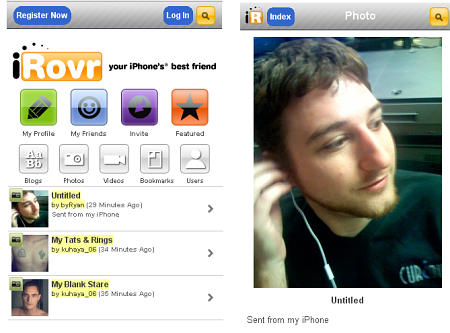
iRovr Launches Social Networking Site for the iPhone

We've seen a lot of new sites popping up designed specifically for the iPhone. What's more, many existing sites have designed iPhone-sized interfaces to make the iPhone user experience of their services more welcoming. The latest of these offerings, iRovr, is a full fledged social network designed specifically for the iPhone.

iRovr offers blogging, photo sharing, video sharing, bookmarking and user profiles - but all sized to fit the iPhone's screen. Media sharing is accomplished through POP email aliases.

Sites such as Digg and Del.icio.us have already offered iPhone an iPhone sized interface. However, the largest sites in social networking land - such as MySpace, Facebook, and Orkut - have not.

Source:http://iphonefaq.org

Orkut faces Facebook challenge

Social networking site Facebook is growing rapidly in India according to a report by comScore. From 238,000 users in January 2007, Facebook has grown by 230 per cent to 785,000 users from India in June 2007. According to the report, Facebook's growth in India was remarkable between April and June 2007, when it added 323,000 users.

I created my Facebook profile in the same period and I find that Facebook is a much better product that Orkut.

But Orkut is still ten times larger than Facebook, with 7.2 million Indian users as of June 2007. It added nearly a million new users during April-June 2007.

Among social networking websites - Orkut, Facebook and Linkedin are very popular in India. While the world leader MySpace does not have much traction here, slugging with 399,000 Indian users.

Here are the Alexa rankings of popular social networking sites in India.


* Orkut = 2

* Facebook = 21

* Hi5 = 53

* Myspace = 65

* Linkedin = 75


About 40 per cent of Indian Facebook users are women, while they constitute 28 per cent in Orkut. Indian companies like NDTV, Info Edge, SBI and Indiatimes are already advertising on Facebook. (Source: Agencyfaqs)

Orkut's popularity is also landing the site in trouble with Indian authorities. It was involved in quite a few controversies, most of which are cases of obscene or defamatory fake profiles and hate communities.

Homegrown social networking sites like BigAdda, Rediff iShare, Fropper, Yaari and Minglebox are gearing up to challenge the international heavy weights. Their success will depend on whether they are able to leverage their local knowledge and understanding of Indian sensibilities to differentiate their offering. The global social networking giants start with a huge advantage - that of a large exisiting userbase - which helps in creating the network-effect and boosting viral growth.

Source:www.cnet.com

Monday, August 13, 2007

Mobile operators see 10 times more potential in social networking

The success of social networking sites such as Facebook, Bebo and even YouTube could represent the next boom for the mobile phone operators.

Revenues from putting so-called user-generated content - meaning content such as videos and blogs created by consumers rather than media organisations - onto mobile phones is expected to rise more than tenfold over the next five years, according to estimates by Juniper Research published yesterday.

Allowing the legion of bloggers, Facebook posters and comedy clip makers to upload and view each other's every movement on their mobile phone could be worth $5.74bn (£2.87bn) by 2012, according to Juniper, from just $576m this year.

"One of the most attractive elements of social networking on a mobile phone is that it's universally accessible so people can look up their friends, update their status or whatever on the move, which for the young demographic is particularly appealing," according to the study's author, Dr Windsor Holden.

Social networking has become one of the fastest-growing internet trends of the past two years. According to internet metrics firm Comscore, Facebook saw users increase 270% from June last year to June this year. It now has more than 52 million users worldwide. MySpace registered lower growth of 72% but still leads the market with 114 million users. Bebo, with a majority of users in Europe, grew 172% to more than 18 million users. The mobile phone companies reckon the people who are using sites like Facebook are exactly the sort of people likely to be interested in using the internet on a mobile phone.

Further research by Comscore shows that people who are already experimenting with the internet on a mobile phone are younger than users who access the web only on a computer. In Britain, more than 25% of mobile internet users are aged 15 to 24, compared with 20% who go online using a computer; a further 41% of mobile internet users are 25 to 34 compared with less than 20% using a computer.

The concern for the mobile phone companies, however, has always been that offering the sort of flat-rate mobile internet access packages likely to lead to an explosion of usage would leave them as little more than big dumb pipes in the air. Their worry has been that once they offer fixed-rate packages, all they can compete on is price and over time they will end up as sidelined as internet service providers (ISPs) have become in the fixed-line internet world.

Some mobile phone companies have tried to retain their position in the value chain by setting up their own UGC services. For instance 3 has scored with its SeeMeTV portal, which lets users upload clips and share them with other 3 customers. SeeMeTV has also created its own social networking service called Moko (formerly Kink Kommunity) with users paying £2.50 a month to keep in touch.

But Frédéric Huet, director at Greenwich Consulting, says that the mobile operators have a real opportunity to persuade more customers to use their mobiles to access the internet by "mobilising" sites such as Facebook.

"I would not be too dismissive of data revenues. If the mobile operators can start increasing take-up of data services they will increase revenues for quite a few years before commoditisation and price competition sees those revenues erode again," he said. "By then the operators will be in a position to offer other services such as mobile advertising.

"The trick is to start building an audience now and the mobile phone operators are starting to understand that."

Sensing this opportunity, several mobile phone companies - such as T-Mobile, 3 and Vodafone in Britain - have launched flat-rate mobile internet tariffs.

Facebook, in fact, is already available on mobile phones in the US through the AT&T, Verizon and Sprint/Nextel networks, with users able to update their profiles and check on their friends. Several of the UK's mobile phone networks are understood to be eagerly chasing deals to add Facebook to their mobile web offerings. In addition, Vodafone has signed an exclusive deal to put YouTube clips on its mobile internet service.

Juniper Research's Dr Windsor, meanwhile, points out that the transition from social networking on the fixed-line internet to the mobile internet could allow new entrants to muscle in.

One such new entrant is Itsmy.com, owned by German tech company Gofresh, which has already signed up more than half a million users.

But these new entrants are going to have a fight on their hands once people can easily update their Facebook status to "I'm on the train" using their mobile.

Source:www.guardianweekly.co.uk

BigAdda, an Indian Youth Networking Site launched by Reliance ADA Group

Social networking sites are the fad of the present day. They offer entertainment, interaction and a lot more. But somewhere they are becoming so common that one cannot go wrong if they are literally compared to the stereotype reality shows too. Both equally hyped but eventually fizz out as time passes by. And there’s yet another social networking site adding to the bandwagon.


Monday, the 13th of August 2007, saw the launch of Reliance ADA group’s ‘BigAdda.com’ which touts itself to apparently be the ‘Indian Youth Networking Site’. BigAdda.com makes possible networking and self-expression by creating, uploading and sharing of videos, photos in a public, yet private, space. Some of the interesting features of this networking platform includes blogs and scribbles, which help the users express, comment and connect, Addas(communities) and forums - all of these catering to one of the most important needs of the youth today - ‘Self Expression’.

Indian social networking site BigAdda.com, plans to gather a user base of 10 million users by 2010 they have already taken a significant step in this direction by acquiring over a 100,000 customers in the last 6 weeks. The company plans to introduce a Music vertical for uploading, streaming and sharing of user playlists. Web Instant Messenger (IM) and wireless interface would also be introduced shortly, which acknowledges the youth’s asynchronous messaging habits and need for connectivity.

Since BigAdda.com has been made with the prime intention of catering to the youth, the panel of speakers too was celebs that are highly popular in their own respective fields amidst the Indian youth community. Present at the event were 5 youth icons to drive their communities online, namely popular glamour photographer Atul Kasbekar, music maestro Shankar Mahadevan, leading Indian female golfer Irnina Brar, top filmmaker Madhur Bhandarkar and stunning Bollywood actress Diya Mirza.


So what exactly are these youth icons going to do on BigAdda.com? As communities are a key driver for growth in the networking business BigAdda has these 5 youth icons joining them for the initiative.

To begin with, Kasbekar will be offering a sneak peak into his shoots and would head a Mobile Photo Contest where users would be induced to shoot and upload photos from their mobiles of which Kasbekar would shortlist the best. And this lucky member would get a chance to work on an assignment with the man himself.

If music is your passion then you can head to Shankar Mahadevan’s Music Adda, who will be encouraging the youth to compose and share their original music. One short-listed member would then get a chance to meet with Shankar and release an album through Big Music Label.

If you prefer being on the golf course, then Irina Brar’s Sports Adda is where you need to be, where she drives a community specially focusing on Girls in Sports. Now this is surely interesting keeping in mind how stereotyped somewhere India is with regards to its choice of sports, sport stars and of course gender too.

Ever dreamt of being Spielberg? If yes, then you can kick start here, not with Spielberg of course, but the Indian directing genius Madhur Bhandarkar, who would steer the Video Category and promote youngsters to share original scripts and video stories.

And if you are simply in awe (just the way our videographer was after seeing the ethereal beauty) of the lovely Dia Mirza, join her Adda, which would steer the Movies category and promote her fan club.

Also present at the event were two leading men from the Reliance ADA Group, namely Rajesh Sawhney, President, Reliance Entertainment and Siddhartha Roy, Chief Operating Officer, BigAdda.

Speaking about BigAdda.com, Sawhney said, “According to the 2007 NASSCOM Report, it is estimated that by 2010 there will be 20 million Broadband subscribers, up from 1 million and 100 million Internet users, as compared to 40 million today. The number of Internet users has witnessed an upswing, and so has their need to socialize online and gain acceptance in the virtual world. Virtual hang-out plays a key role, because it gives them the space to be amongst friends and peers, while sharing an image of their own, which they would like to project. BigAdda.com aims to evolve a youth community, inclusive and aspirational and create a youth culture that will be cool and aspirational for them.”

“Music, Fashion, Movies and Sports are something that cuts across all segments and age groups. The idea was to create a platform where the fans/users can talk/share with their icon. Going forward, we plan to increase our community drivers and supplement it with innovative marketing and promotional activities,” continued Mr. Sawhney.

Giving his take on BigAdda.com Siddhartha Roy, Chief Operating Officer, BigAdda said, “As a society, we are at a moment of transition when social relationships may no longer be restricted to face-to-face interactions in our own immediate surroundings, but also include a large number of relationships conducted over vast geographic distances. Photos, Videos and Music are the key drivers of online consumption today. Hence, we wanted to let our users upload content of their choice, as one of the many features on BigAdda.com, as it gets to showcase and express their personality. Till date, there has not been one particular destination for Indian and International video content, a void which BigAdda will fill. In just 6 weeks of the site being in the test phase, BigAdda.com has over 12000 videos with over 5,000 television advertisements.”

One really wonders that with the likes of highly renowned social networking sites like Orkut, Facebook, MySpace and zillions more, where does BigAdda.com actually stand? Perhaps as the site is banking on the power of the youth, especially keeping in mind the fact that around 54 percent of the present Indian population is below 25 years of age, there may be a bleak possibility that this very youth may consider BigAdda.com as their haven. A place to express, learn and share.

Source:www.techshout.com

Facebook Source Code Leaked to Internet

Social networking site says the leak didn't compromise user data.

The source code that powers the user interface for popular social networking site Facebook was inadvertently exposed over the weekend due to a misconfigured Web server.

The source code, which was posted Saturday to a blog called Facebook Secrets, was still posted Monday on the blog.

A spokeswoman for Facebook said in a statement e-mailed to Computerworld that "a small fraction of the code that displays Facebook Web pages was exposed to a small number of users" because of a misconfigured Web server that was fixed "immediately."

The incident was not a security breach "and did not compromise user data in any way," the spokeswoman said. "Because the code that was released only powers the Facebook [user interface], it offers no useful insight into the inner workings of Facebook," she added.

However, Pete Lindstrom, a senior security analyst at Burton Group, said that anytime source code is accidentally revealed, "there is potential for an increase in risk." He added that when a company dismisses the security implications of such an incident, there likely really are security issues.

"There are enough folks out there trolling the Web sites and pull that code who will be perfectly happy to try to identify vulnerable areas that could be exploited," Lindstrom said. "If you're release source code to the wild, you're going to have some level of increased risk associated with it. I can't think of a case where you wouldn't."

Nik Cubrilovic, a developer and contributor to TechCrunch, which originally reported the source code leak, blogged that the code could be used by outsiders to better understand how the Facebook application works. With that knowledge, Cubrilovic said, those outsiders can find additional security holes or bugs.

"From just this single page of source code, a lot can be said and extrapolated about the rest of the Facebook application and platform," he wrote. "At a quick glance, I know that I can see some obvious things in the code that both reveal certain hidden aspects of the platform and give a potential attacker a good head start.

"[Facebook] will also need to take some very quick short-term measures to mitigate the risk to users since you can bet that right this minute there are hundreds of potential attackers pouring through the leaked code and probing their systems," he added.

Source:www.pcworld.com

Sunday, August 12, 2007

Advertisers find new headaches in lawless world of social Web sites

First came the soaring ascent of online social networking sites and now comes old fashioned soul searching about a sprawling universe where staid advertisements can scrape up against profiles of giddy young professionals and pages devoted to self-proclaimed angry "straight, white men."

While sites like Facebook, MySpace, Bebo and Habbo Hotel have a powerful allure, the companies that run them are finding themselves on the front lines of criticism about fast-evolving standards. Some of the criticism in Britain involves advertising for junk food that is migrating to the sites from children's television programming, where such ads are now banned, and corporate concern about employees distracted by time-sapping virtual networking.

For traditional advertisers rushing headlong into this new territory to reach tantalizing, young users, the ultimate nightmare is the surprise of sharing virtual real estate with risqué material or racist rants.

"Ultimately there are going to be mistakes and unfortunate incidents," said Debra Aho Williamson, a senior analyst with the research firm, eMarketer, and the author of a report predicting that global advertising spending on social networks would grow to $3.6 billion by 2011 from $445 million this year.

"Social networking content is very dynamic and it's always changing," she added. "We're moving to a world of user-generated content and it's changing on a minute-by-minute basis. I think marketers are just going to have to get used to it."

Online advertising is a vital part of development for social networks, which have grown dramatically in the past two years with MySpace attracting more than 114 million visitors internationally in June, followed by Facebook with 52.2 million and Bebo at 18.2 million, according to comScore, an Internet tracking service. And all of those sites are feeling some growing pains.

In London, with the number of Facebook users swelling, government agencies and six companies, including Vodafone, Virgin Media and First Direct, made a jumpy, temporary exodus from the site this month. The companies withdrew advertising accounts from Facebook after their brands surfaced in blind purchases alongside a page for the anti-immigrant, right-wing British National Party.

Now the party's Facebook profile has been whisked clean of advertising, but the government's Central Office of Information has temporarily pulled advertising until it receives assurances about appropriate placements.

Other companies are jittery for other reasons; Credit Suisse and Dresdner Kleinwort cut off company access to such sites because of concerns about unproductive use of work time.

"Access to Facebook is denied by our automatic Web site filtering software as it may contravene our Internet use policy," said Murray Parker, a Dresdner Kleinwort spokesman. "Dresdner Kleinwort only provides Internet facilities to staff for the purpose of conducting company business."

MySpace and Bebo, which has evolved into the most popular social site for European users, have already given their assurances to British government authorities. Facebook, as well, announced last week that it was developing new systems to allow advertisers more control.

But the controversy in Britain has had an impact on all companies in the social networking category, many of which have been taking steps to highlight their ethical responsibilities, by hiring special "safety officers" or to refuse ads for profile pages.

"Bebo, unfortunately, gets tarnished with the same brush as Facebook, which is very new in the U.K. market," said Mark Charkin, head of Bebo sales for England and Ireland.

The British flap happened just after Bebo rolled out an edgy new series called KateModern, which it had commissioned from the producers of infamous and fictional Lonelygirl15, a Web series about a young girl named Bree. The ambition is to attract more users to the site, but also to tap a new revenue pool by integrating products into the story line to give advertisers greater exposure instead of click-through advertising banners.

The advertising is just starting to surface, like a glimpse of a Microsoft brand on a computer. But Charkin said no ads would appear in the more serious and dramatic scenes. Orange, Proctor & Gamble and Buena Vista, have all signed up to give their products bit parts, according to Charkin.

Bebo and Habbo House, an animated world with sites in 19 countries that draws users between the ages of 10 and 16, are both integrating candy and food advertisements into their sites, which has drawn particular criticism in England, where authorities banned junk food advertisements in April for television programming aimed at children aged 4 to 9 years. At the start of next year, the ban will extend to programs for viewers younger than 16.

Bebo has been running a campaign for Skittles candy, "A World of My Own," that offers users a chance to create their own ads. Habbo Hotel, with its headquarters in Helsinki, Finland, incorporates brands like Burger King or Juicy Fruit gum, into the public spaces where players hang out in rooms with shiny tile floors and counters that look very similar to a fast food restaurant. "We think the future is having users acting or interacting with your brand. How do we solve that?" said Henrik Hoglund, who leads advertising sales for Habbo. "By setting up a competition, a quest and other things that can activate brands."

Habbo, according to Juhani Lassila, a company spokesman for Sulake, the parent company of Habbo, has adopted a code of following the rules in different countries; in the case of Britain, it is not showing the Burger King advertisements on local sites.

A Bebo spokeswoman, Sarah Gavin, said the company was working with the British regulator Ofcom and was following guidelines from the U.K. Advertising Standard's Authority.

Some institutions have reacted by building their own walls. A number of schools, companies and government authorities are filtering out social networks by blocking access. That counter-reaction has been building over the past three months, said Greg Miller, the head of sales for Email Systems, a Web services company, which also filters billions of mail messages a month for hundreds of private and public clients.

"Social networking has come into the fore in the work space," Miller said. "People knew it was there, but they were quite happy to not necessarily ignore it, but to accept it. But now it's gotten to the point where they can no longer tolerate it."

But the desire to communicate about personal issues is a powerful force. One of the newest entrants into the field is an international Web site called Respectance, which is creating a virtual memorial for the dead that enables surviving friends and relatives to create and share user-generated tributes and obituaries.

Ultimately, the company's founders and investors want advertising, but they are moving into untrammeled territory while striking the right dignified tone. "This has to be handled very carefully," said Barend Van den Brande, a partner in Big Bang Ventures, a Belgian venture capital fund that has invested in Respectance. "What you don't want to see is an ad for a BMW on your grandmother's obituary."

Source:www.iht.com

Thursday, August 9, 2007

Orkut becomes 'media' popular social networking site

Pop singer Paris Hilton promoted her new music album 'Paris' on YouTube. Fashion brands, such Ralph Lauren, Gap, Victoria's Secret, Calvin Klein, Adidas and more are on YouTube connecting with the community through videos, commercials, behind-the-scenes, footage and fashion shows.

India is beginning to witness a similar trend, though it is at a very rudimentary stage. Orkut, a more popular social networking site, is attracting the attention of marketers. Naturally, brand advertising potential is huge. And some are already on board.

Meow 104.8 FM, the exclusive women FM station, is present on Orkut. Anil Srivatsa, COO, Radio Today, who also hosts Between the Sheets on Meow, enters into a discussion with the community and regularly updates audiences regarding his shows through Orkut. "It is an opportunity to engage with audiences, create a viral effect and spread the word about the brand," says Srivatsa.

Besides Orkut provides the ideal environment to promote a channel such as Meow, since it is positioned as a "talk format" radio station.

Srivatsa says he has made 700 friends in 30 days, and through those 700, he now reaches 2000 people. "Being on Orkut creates a buzz." Srivatsa hopes to have a meaningful business partnership with Orkut in the near future and is in talks with prospective advertisers.

Harish Bijoor, CEO, Harish Bijoor Consults, says that social networking websites such as Orkut, YouTube, Fropper and Facebook give marketers a well profiled target audience. This is a golden opportunity for marketers, since traditional media is mostly mass, and one never knows if the money spent is actually leading to conversions.

"Segmentation allows the marketers to get close to its consumers, and therefore, targeting them is easier," says Bijoor

Research findings from JuxtConsult show enthusiasm amongst surfers to network. According to JuxtConsult's India Online 2007 survey communication, online networking is a hot trend, be it social or professional. Mrutyunjay, Director, JuxtConsult, says the popularity of social networking sites such as Orkut, Friends, Tagged, Fropper and Hi5 is a positive sign for Indian marketers.

For one, social networking sites are great way for spreading the word says Sachin Bhatia, co founder and chief marketing officer, MakeMyTrip.com. The travel portal is also present on Orkut.

"Users of social networks are a close-knit community, where opinions are trusted, or at least considered," Bhatia says. In fact, social networking sites can serve as great opportunities for the socially ostracized products such as cigarettes and liquor points out Bijoor.

But despite the potential of the medium, Indian marketers are sitting on the wall observes Bijoor. One worry is tampering of the content. Once the content is online, the brand owner has little control over the matter and could make the brand vulnerable.

Though there are technologies to prevent such a situation, marketers are in no hurry it seems. Another reason for the marketer's lack of enthusiasm is the size of social networkers. "It is small; just 11 million of the total of 30.23 million urban Internet users," says Mrutyunjay.

"Once these sites have the critical mass, marketers will begin to show interest," points out Bhatia of MakeMyTrip.com. On the other hand, Bhatia says that this is the best time to acquaint oneself with the medium, in terms of how best to exploit it in the future. MakeMyTrip has a two-member social networking team in place.

While social networking sites are yet to catch the fancy of advertisers, online communities of different brands such as sunsilkgangofgirls.com, Whisper's BeingGirl.co.in, ITC's website for Bingo Chips or Oktatabyebye.com, continue to get popular.

Source:www.televisionpoint.com

Google explains privacy policy on YouTube

Google has posted a video on YouTube that explains aspects of its privacy policy.

Peter Fleischer, Google's global privacy counsel, said in a blog post on Wednesday that Google had launched the video to explain "cookies, IP addresses, and logs" to "non-techies". YouTube is owned by Google.

ZDNet.co.uk understands that Google's privacy video is part of an attempt by the search giant to allay EU privacy concerns.

However, the official Google line is that an explanation of server logs and cookies is necessary in the interests of "transparency, and to empower you to make informed decisions about how you want to use our services".

In the video, entitled "Google Privacy Policy: Plain and Simple", Maile Ohye, a senior support engineer, says: "To improve [Google] search results, as well as maintain security and prevent fraud, we remember some basic information about searches. Without this information, our search wouldn't work as well as it does or be as secure."

The security reasons for retaining server logs are not raised in the video. However, a Google spokesperson said: "By being able to look at data trends over time, Google is better able to identify hacking attempts against Google systems and those of our users."

Fleischer has been unwilling to divulge any more information about Google security practices in the past, so as not to undermine those practices.

The video and Fleischer's Google blog post make no reference to EU privacy concerns over Google's server log retention period.

The Article 29 Data Protection Working Party in May published a letter saying it was concerned that the "storage period of 18 to 24 months on the basis indicated by Google thus far does not seem to meet the requirements of the European legal data-protection framework." The watchdog has also said that Google's cookie-retention period is "still too long", despite having been reduced to two years.

Besides Google, the EU is to also probe other major search engines' log-retention policies.

Source:www.zdnet.co.uk

Wednesday, August 8, 2007

Facebook Faces Up

As the social networking behemoth meets new challenges, three startup college networks are waiting in the wings

Facebook has had a rough ride of late. Users complain about the site's frequent shutdowns, with some observers seeing the malfunction as a possible troubling security breach (see BusinessWeek.com, 07/31/07, "Facebook Outage: Wakeup Call").

And though the news media continue to talk about the network's rapid growth and market dominance, commentators have expressed misgivings about Facebook's ability to sustain and monetize that expansion (see BusinessWeek.com, 8/6/07, "Fogeys Flock to Facebook") and (see BusinessWeek.com, 8/6/07, "Too Old for Facebook?").

Now, with founder Mark Zuckerberg heading back to court Aug. 8 to defend himself against accusations that he stole the site's concept from ConnectU, another collegiate social network with its roots at Harvard, the vultures are on the sidelines, flapping their wings.

Staying in School


Not least among them are those looking to fill the void they claim Facebook has left behind by deserting its core audience, college students. According to ComScore, 71% of users are now outside the college age-bracket. As of May, anyone could join the network, whereas users once needed a .edu e-mail address (as proof of college affiliation) to join.

But the demand for student-only online spaces—the very thing that made Facebook take off in the first place—remains. And that's where three ventures by young alumni—Off The Record, CollegeTonight.com, and CollegeWikis.com—hope to come in. Their success and strategy depend on staying loyal to that college niche, and they're looking to find ways to complement rather than compete with the networks students already use.

Niche marketing has been the strategy of choice for many new networks in the last year (see BusinessWeek.com, 3/14/07, "Social Networking Goes Niche"). Users have responded well to being a part of a distinct community, whether grouped by profession, ethnicity, or school. And advertisers like that specificity too.

College-Specific Blogs


Furthermore, research done this April by iProspect shows that among the younger age group, the top social networks have overlapping user-bases. For each of the eight social sites in the report, 30% to 40% of 18- to 24-year-olds surveyed reported some involvement, which means most respondents are frequenting more than one of the sites. According to iProspect, the likely overlap is three to five networks per average student user. If that's true, the niche model just got a whole lot more interesting to mainstream business.

College campuses provide an ideal niche case, not only because they are self-contained, but because they are communities with ample social needs and active online populations. "[They] are probably the best example we've seen of communities that can be easily activated by online media," says Columbia alumnus Doug Imbruce. This September, Imbruce is launching a series of college-specific blogs called Off The Record, where students can post information about their schools, their peers, and their professors and administrators, while using a pseudonym.

Content will be managed by student-editors reporting to an editor-in-chief in Off The Record's New York offices. Though the controlled structure and pseudonyms may seem impersonal, Imbruce promises that editors will be chiefly concerned with controlling logistics, technology, and privacy. He predicts a site culture in which students collectively feel free to post the truth of college life as they see it. By virtue of its selectivity—students can only contribute to their own college's page—Imbruce believes Off The Record is "more intimate" than a larger network or more public blog.

Pep Squad

Given the specificity of the information that will be contained within each blog thread, Imbruce also promises the sites will remain exclusive to each college. "We're looking to create college sites," he says. "We may add more content, sports scores, and news, but we will stay vertical within these communities."

Student-exclusive networks provide users with a sense of importance: It's easy to become a big fish in a small, students-only pond. Emory University alumus Zach Suchin hopes to capitalize on this desire. His venture, CollegeTonight.com, will establish distinct networks for each U.S. college, where students can post information about parties, concerts, and social events, download contact lists to their mobile phones, and make plans to meet up. In September, CollegeTonight will launch a nine-month nightlife tour of 129 sponsored events at colleges across the country. Business partners already include car manufacturer Subaru (JASDAQ) and CBS (CBS), which will sponsor the concerts and parties on the tour in the hope of reaching Suchin's user base.

Suchin proposes the site as a tool chiefly for "the trendsetters and the tastemakers" and, notably, wealthy students with disposable income (the tour begins at Ivy League schools Yale and Brown). And it's actively promoting a sense of exclusivity and privacy. Former FBI profiler John Douglas crafted the site's privacy settings and users must have a .edu e-mail to join. "That will never change." Suchin says. "We're trying to create the sense of community that Facebook abandoned."

Weaning Away From Facebook

As it turns out, for now at least, students are loath to leave the network that still dominates online socializing. "Facebook has such a strong hold on the college social networking market that people are [still] interested in developing things for Facebook," explains Joe DiPasquale, founder of CollegeWikis.com. He hopes to strike a balance by creating college-specific sites with a widget that links to Facebook.

On CollegeWikis.com, students can e-mail questions about local restaurants, classes, and dorm life. Each question and e-mailed response from other students becomes instant content on the Wikipedia-style Web site, a viral format that DiPasquale believes students are more likely to use than mass administrative e-mails, which most students simply delete. Since its launch in April, CollegeWikis has expanded to 60 schools nationwide and achieved 15% penetration at some campuses.

Meanwhile, on CollegeWikis.com's sponsored Facebook application, SuperWall, users post college-specific information that is instantly communicated to the virtual message walls of other registered users at their college. SuperWall is currently one of Facebook's 10 most popular applications.

Room for Everyone

Again, the appeal of CollegeWikis.com is its specificity. A site is created for any college if a student submits a request to the central wiki page. Within that wiki, users can join or create lists for their major, their class, and their dorm. Already the average college wiki page has 216 more-specific lists. Says DiPasquale, "When we did focus groups, we found people wanted the sites as specific as they could be."

DiPasquale's dual approach to advertising and site sponsorship—be authentic, be transparent—epitomizes these niche networks' business model. Young consumers are expert multi-taskers so there is room for multiple offerings within their expanding online life. These three young entrepreneurs hope their offerings will complement one another and Facebook, creating more business for all of them. Says Off the Record's Imbruce, "Media in this group [are] additive and not really competitive." Though he's talking about college students, the insight applies to online business overall.

Source:www.businessweek.com

Education 2.0: The Best Social Networks for Students

Back when your parents were in school, they actually had to initiate in-person conversations if they wanted a social life. Of course, that was when they weren't walking two miles to school, in the snow, uphill -- both ways.

You pesky kids have it so easy these days with your darn social networks!

Online social networks have certainly made it easier to make -- and stay in touch with -- school friends. Whether you're trying to get back in touch with an old school posse, or looking for a new one, the process is less risky and can often be more fruitful when it happens online. And it can help you find the right group, too. Why be alone this fall when you could be getting together with fellow members of the "Emo Is The New Rad" group on Bebo?

But no matter how big of a slacker you are, you surely won't have time for all the social networks out there. No worries. There is no need to pledge allegiance to just one. At last year's Web 2.0 Summit, Marc Canter, chief executive officer for Broadband Mechanics, estimated that the average user is an active member of five social networks.

So if you're going to choose five, you might as well be judicious in your selection. Here are Wired News' top picks.

MySpace

Despite a reputation for being trashy, ugly and over-hyped, MySpace is still the largest social network out there. In June, the site claimed 70 million active users, with one in four Americans having logged in at some point. Teenage members dominate the site, which is why MySpace has the unfortunate reputation of being a breeding ground for pedophiles. Forrester Research reports that 80 percent of 12- to 17-year-olds use MySpace weekly.

WIRED This year MySpace added a page for the 2008 presidential candidates, as well as a MySpace News page, which could be helpful for your history courses.

TIRED It's doubtful that its users will ever take MySpace that seriously. A quick browse through the site will leave you with more hoochie mamas than you'll ever have time for.

Facebook

Even though Facebook started out for students only, more than half of the site's users are out of college, meaning your membership should still be useful after graduation. Currently, the site has 47,000 regional, collegiate and high school groups populated by 31 million active users. In preparation for the inevitable roommate clash, don't forget to join CouchSwap, a new travel application made specifically for Facebook. It lets you offer, find and rate couches to crash on. Perfect for the urban nomads of the world!

WIRED Within university groups, there are subgroups organized by dorms, colleges, hobbies, food affiliations, political opinion, you name it. If you can't find friends within your groups of interest, your keyboard may not be plugged in.

TIRED As Facebook grows, so does the number of random groups that seem to have no application for your real social life. Unless you really do want to meet other Rubik's cube enthusiasts.

LinkedIn

There is nothing cute or sexy about LinkedIn, but when it comes time to wean yourself from the parentals, you'll be thankful for this more business-oriented network. LinkedIn has over 12.5 million users and is growing at a rate of approximately 200,000 per week. Think LinkedIn is too uncool if you're still in school? Guess again: "Students can use LinkedIn to find mentors and to perform research," said Kay Luo, a spokesperson for LinkedIn. "It's a great place to find industry contacts for research papers and case studies. It's wise to establish relationships and maintain your network before you need it."

WIRED Nearly half of LinkedIn's users are over 34, meaning they have the money and power to get you a job.

TIRED Once you make useful contacts, what do you do with them? You can't share much content on LinkedIn beyond a souped-up resume, so be sure you get real contact information along with your introductions. Then invite your new contacts to Facebook -- it'll make them feel young and hip.

Bebo

When you're ready to network outside of the United States, Bebo is a good place to start. It is the third-largest social network in the space, with the majority of its users in the U.K.

WIRED Bebo is great for music lovers: The site links directly to iTunes music. Bebo Bands, which launched in July 2006, is the home of over 20,000 group and artist profiles.

TIRED It isn't that easy to find friends. Bebo will search through your address book for people you already know, but finding new friends by location or interest is not that easy if you don't join groups.

Hi5

Another way to make friends beyond the 50 states is hi5, a social network with over 60 million registered members. "Since members post photos and content about themselves, new students can get to know each other better using hi5," said Ramu Yalamanchi, chief executive officer for hi5. "They can also stay in touch and see how summer break was spent." The site is the number one social-networking location in Mexico, South America and Central America. Yalamanchi said 30 percent of hi5 members are from Europe, 25 percent from hispanohablantes, or Spanish speaking markets, and 23 percent from North America.

WIRED Most hi5ers are between 15 to 25 years old, making it useful for back-to-school time.

TIRED If you don't habla Español, hi5 may not be for you.

Friendster

Poor Friendster has a bit of a social-network-that-was reputation, but it still has over 47 million users in 75 countries. It may not dominate the American social-networking market but it has a strong international presence. The site had 9.5 billion page views in June, with the average user staying online for 208 minutes.

"In the back-to-school period, it kicks into overdrive," said Jeff Roberto, a spokesperson for Friendster. "On the homepage, you can add up to three schools and three colleges to your profile. Every time you add a school, we go and find the same people that went to that school during the same years and pull all those profiles to you so that you can discover new people and new content relevant to your school."

Since Friendster requires users be at least 16 to sign up, it is less useful for high school students than for college and post-college students.

WIRED School-centric profile searches makes it easy to find new friends at your new school -- or old friends at your old school.

TIRED Users in the United States tend to use Friendster less for communication, and more for simply posting updates about themselves and their friends. Comments are more of an ode to your friends than an actual timely message.

Craigslist

If all else fails, there's always craigslist. Lonely? You can post a personal this morning and get a couple dozen come-ons from strangers by this afternoon. Plus, you can also use the site to find activist groups, arts events, theater companies desperate for your juggling skills or that single-speed Bianchi you've been craving.

WIRED No photos, songs, blogs, friends, recommendations, pokes, walls, groups, videos, widgets or background graphics to distract you.

TIRED No photos, songs, blogs, friends, recommendations, pokes, walls, groups, videos, widgets or background graphics to entertain you.

Source:www.wired.com

Tuesday, August 7, 2007

Music Publishers Sue YouTube

In September 2006, the same group won a judgment against a peer-to-peer filing service, StreamCast Networks.

The National Music Publishers' Association this week joined a class action lawsuit alleging that YouTube and its parent company Google have committed massive copyright infringement.

The group announced Monday that it is rallying along with the Football Association Premier League Limited and others in the suit filed in the U.S. District Court for the Southern District of New York.

"Copyrighted music is a huge draw for YouTube's users," the NMPA said in a prepared statement. "This music can be found in many of YouTube's clips, in both pre-existing commercial content and videos."

A spokesperson with Google was surprised and disappointed that the NMPA has elected to take this route.

"We have concluded historic licensing agreements with several NMPA members and have been in licensing discussions with others," Google Managing Litigation Counsel, Michael Kwun said. "Many song writers and music publishers view YouTube as a promising promotional platform for connecting with their fans and as a unique revenue opportunity. "

NMPA President and CEO David M. Israelite said the group is "very concerned about YouTube's approach to copyright."

"We are joining the lawsuit to protect the interests of music publishers and songwriters, whose creative works are being used without permission or compensation by YouTube, he said."

The NMPA is a music publishing industry trade association promotes and advances the interests of music publishers and their songwriting partners, while fostering a business creative and financial growth for more than 600 members. It was established in 1917, and is active globally in terms of protecting copyrights.

In September 2006, the group won a judgment against a peer-to-peer filing service, StreamCast Networks.

The Football Association Premier League, a British soccer division with an estimated 2.6 billion spectators, filed the lawsuit against YouTube in May. The lawsuit is one of many that Google and YouTube are currently defending.

Source:www.informationweek.com

The global face of social networking

A new report from comScore reveals that several of the major social networking sites have experienced dramatic growth over the past year, and the trend is global.

Social networking continues to rise in popularity with Internet users across the globe. Recent figures released by comScore reveal huge rises in the number of visitors to the largest of the social networks. What was once considered a fad now attracts audiences that put it in the mainstream.

"Typically we see that, whenever that happens, advertisers will follow the eyeballs,” said comScore’s EVP Jack Flanagan, via Clickz.

Tagged.com experienced the highest rate of growth, up 774 percent, visitors rose from 1,506 last June, to 13,167 this June. During the same period Facebook achieved a 270 percent growth rate, Bebo 172 percent and MySpace 72 percent. MySpace attracted almost 114 million visitors during June, 2007.

The popularity of a social networking site appears to be dependent on the audience's geographic region. Both MySpace and Facebook attract predominately North American audiences, around two-thirds according to comScore.

Bebo is the choice of European social networkers with 63 percent of its users coming from that region and Friendster attracts 89 percent of its audience from Asia-Pacific.

Orkut is the darling of users in the Asia-Pacific and Latin American countries, according to the report.

"Literally hundreds of millions of people around the world are visiting social networking sites each month and many are doing so on a daily basis," said Bob Ivins, ComScore’s EVP of international markets.

"It would appear that social networking is not a fad but rather an activity that is being woven into the very fabric of the global internet," added Ivins.

Source:www.bizreport.com

Recruiters scour social networking sites - Indian Overview

Orkut, Linkin, Facebook and other similar popular social networking sites are fast doubling up as the modern day employment exchanges with job seekers as well as companies and recruiters head hunting for talent.

The social networking sites, immensely popular with the netizens, especially the young, are having number of ‘communities’ helping both job seekers and employers.

“Searching for the right person for a job is always a challenge,” says Gauri Sarin of Approach Talent Solutions. “So, there is a rising trend among the companies and recruitment agencies to use social networking sites to look for the right person,” she adds.

With 100 million Internet users in the country, India is now the fourth largest country in terms of Internet penetration, a recent Assocham study points out.

According to Assocham, E-recruitment is gaining ground as a preferred medium of hiring in India. Especially for job seekers, the Internet has opened up the world of job searching, turning it into a 24-hour-a day market place. Internet is arguably the most immediate, convenient and comprehensive medium for employment seekers to research for jobs.

While searching for ‘jobs', communities like Orkut throw up about a 1,000 odd related communities such as 'IT jobs India walk-ins','Freshers','Retail Jobs in India', 'Walk in for Jobs', Job Sampark' etc.

Staffing services providers like Cloud 9 India, Pathway Recruitment Agency use such sites as a platform to hire. They have links to their own websites.

Populated with thousands of members each of these communities have a huge database of job seekers and can reach them within seconds. “Of all new services on the Internet, social networking sites are most promising because these community-driven sites have the ability to leverage their user base across other verticals,” says R Sunder, president, Times Business Solutions.

He adds, “Most of the growth in the social networking space has happened in the last one year. It will continue to accelerate as more people gain high-speed Internet access. It has come down to mobile phones and with web 2.0 coming to market, the future seems to be limited only by the imagination.”

Young people are making most of it. Says Neha Kapoor, a fresh graduate from Kanpur, “I got a job in one of the best BPOs in Delhi thanks to a ‘scrap’,” a term used by Orkut to describe the messages that are posted on the net.

B Sudhir, software engineer, 25, moderator of a community ‘Walk in for Jobs’ in Orkut says, “I started this community as a hobby. Having gone through the hardships of finding a job, I wanted to create a platform for freshers.”

His community claims to have membership of over 30,000 members. Sudhir says, “Other than the recruitment agencies, many corporate houses directly post their requirements on the site.”

He also has a blog whose members receive job opening postings in their mail boxes. Although most of these services are free yet there are ways to monitise these communities by dividing the jobs into free and paid categories, in which the recruiter pays for some specific advertisements.

There are many networking sites other than Orkut such as Facebook, Myspace,Yaari among other popular professional networking sites like Linkin, Ecademy, Doostang, Xing, Plaxo, et al.


Linkin, a business oriented social networking site, is mainly used for professional networking, with a membership base of 12 million across 400 economic zones it is very popular in the US. Linkin allows regular users to maintain list of contact details of people they know and trust in business. It is now fast catching up in India.

“Such sites cater to those who require fresh blood like BPO’s and especially IT industry. While Linkin is effective for the senior levels,” says Sarin.

According to Assocham survey, junior,mid-level and senior executives accounted for more than 50 per cent of the online job seekers.

Also 46 per cent of the online job seekers fall between 26 to 35 age group. Thus with an estimated 120 million Indians logging on to the net in 2007-08, head hunting through networking sites is a trend that will only increase.

“While social networking is one of the current mainstream media buzzwords, in the recruitment and staffing space it is all about helping employers to find and match candidates to open job positions and build a talent pool. Whether social networking is the answer to recruitment is yet to be seen,"says Sunder.

Source:www.onrec.com